What Students Should Double-Check Before Trusting an AI Generated Lecture Summary
Did you know that nearly 40% of students now rely on automated tools for their study notes? While modern ai technology offers incredible speed, it often misses the nuance found in a live classroom. Relying solely on these tools can lead to significant gaps in your academic performance.
What Students Should Double-Check Before Trusting an AI Generated Lecture Summary
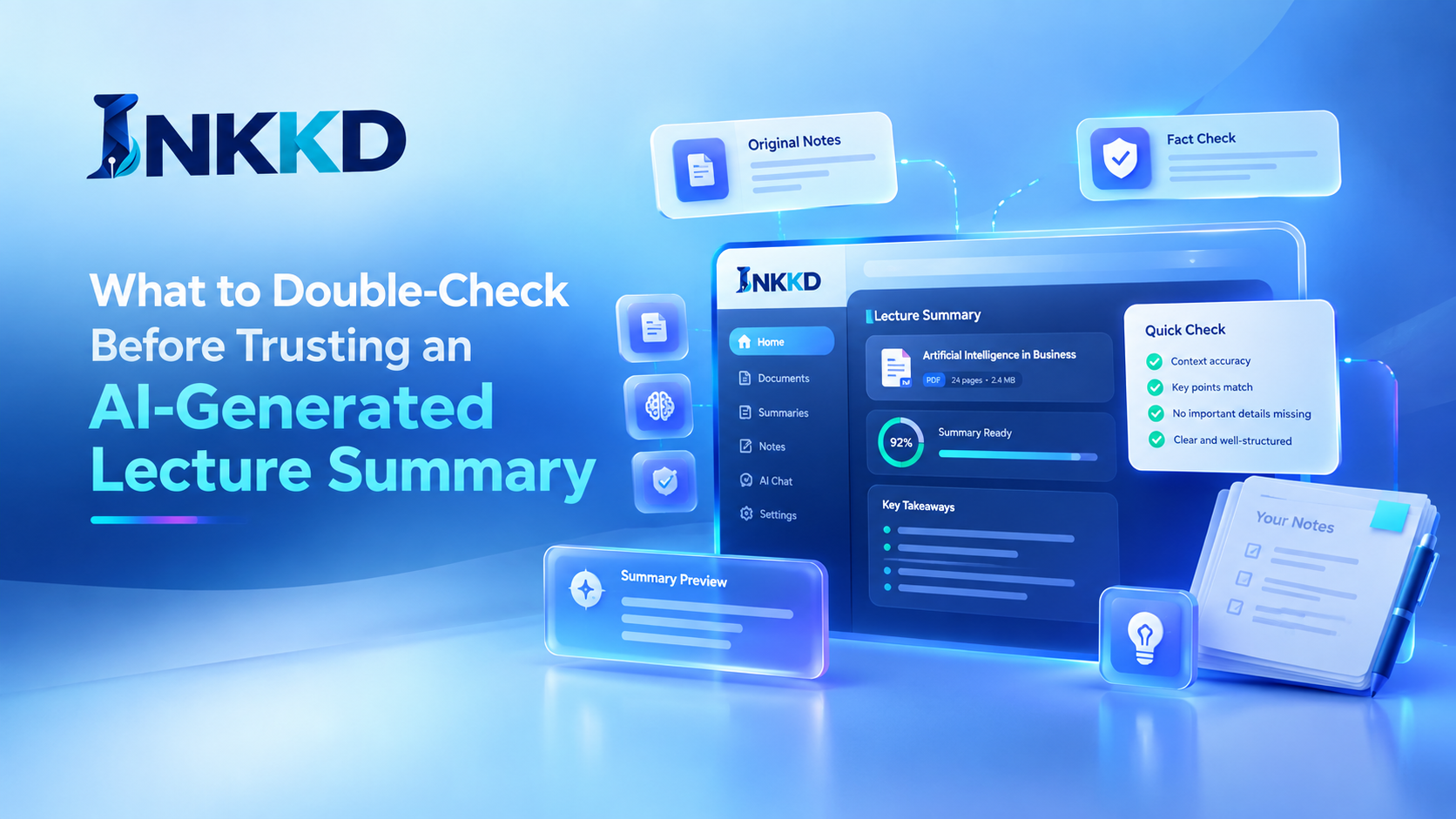
Before you trust an AI-generated lecture summary, perform a few essential checks. While these tools save time, AI content reliability is not always guaranteed. Always treat your lecture summary as a draft rather than a final, perfect record.
Compare the Main Argument, Key Points, and Learning Objectives
Start by comparing the AI output with the main goals of the lecture. Does the summary capture the primary idea, or does it focus on minor details? Make sure the learning objectives match the professor's original intent.
The following table shows the difference between a reliable summary and a potentially flawed one:
| Feature | Reliable Summary | Flawed Summary |
|---|---|---|
| Core Argument | Matches syllabus goals | Focuses on irrelevant trivia |
| Definitions | Includes clear explanations | Omits key terminology |
| Fact Accuracy | Matches lecture slides | Contains invented data |
| Tone | Neutral and objective | Overly confident but vague |
Look for Missing Definitions, Examples, or Qualifications
AI models often focus on brevity, which can remove important context. Specific definitions, examples, or explanations may be missing from the summary. Authenticating AI summaries requires you to manually add these missing details to make sure the original meaning remains intact.
Verify Facts Against Lecture Slides, Notes, and Recordings
The best way to check accuracy is to compare AI-generated content with your original study materials. Cross-reference dates, names, and technical terms with your lecture slides and notes. If the AI contradicts your notes, always rely on the original source material.
Watch for Fabricated Details and Confidently Stated Errors
AI-generated content can sometimes sound very confident even when it is factually incorrect. This is often called hallucination and can cause you to study false information. Be careful with claims that seem too specific or are not supported by your class materials.
How to Verify Sources, Context, and AI Content Reliability
Critical evaluation is essential when using AI tools for academic study. Although these systems can be useful, they do not always provide perfect results. Take active steps to make sure your notes are accurate and trustworthy.
Use Academic Textbooks, Journals, University Resources, and Official Websites
To improve content reliability, cross-reference AI summaries with trusted academic materials. Start with your core textbooks and peer-reviewed journals. University library portals and official government or institutional websites can also provide reliable information for your research.
Check Whether Cited Sources Actually Support the Claims
AI models can sometimes provide citations that look professional but do not actually support the information. Check each important citation by opening the original source. Confirm that the source supports the specific claim made in your summary rather than simply discussing a similar topic.
Distinguish the Lecturer’s View from General Scholarly Consensus
Lecturers may present specific interpretations or theories during a lecture. AI summaries can sometimes mix these personal views with broader academic consensus. Check whether a statement is a widely accepted fact or a specific argument presented by your professor.
Identify Outdated Information, Simplified Explanations, and Missing Contradictions
AI tools may sometimes use outdated information or simplify complex academic concepts too much. Look for missing details, different viewpoints, or contradictions that could change the meaning of the lecture. If a summary seems too simple, it may not contain enough depth for university-level work.
Use Critical Evaluation Before Relying on an AI Lecture Summary
Effective studying requires careful evaluation when using AI-generated lecture summaries. Separate verified facts from personal interpretation to maintain academic accuracy. This helps ensure your notes reflect the actual lecture content rather than machine-generated errors.
Separate Verified Facts from Interpretation and Personalised Commentary
Carefully review the output to distinguish objective information from subjective interpretations. When you validate AI-generated information, you reduce the risk of including unsupported information in your academic work. This step is important for maintaining AI-generated summary credibility.
Mark Uncertain Claims for Further Investigation
Highlight statistics, dates, definitions, or other claims that seem questionable during your review. Performing AI content reliability checks helps you identify gaps or possible errors in the generated text. Use these marked areas as a guide for further research.