How Salford Media Students Can Turn Interview Recordings Into AI Notes 2026
Automated note generation offers powerful efficiencies for media students balancing rigorous academic schedules with ambitious production goals.
How Salford Media Students Can Turn Interview Recordings Into AI Notes 2026
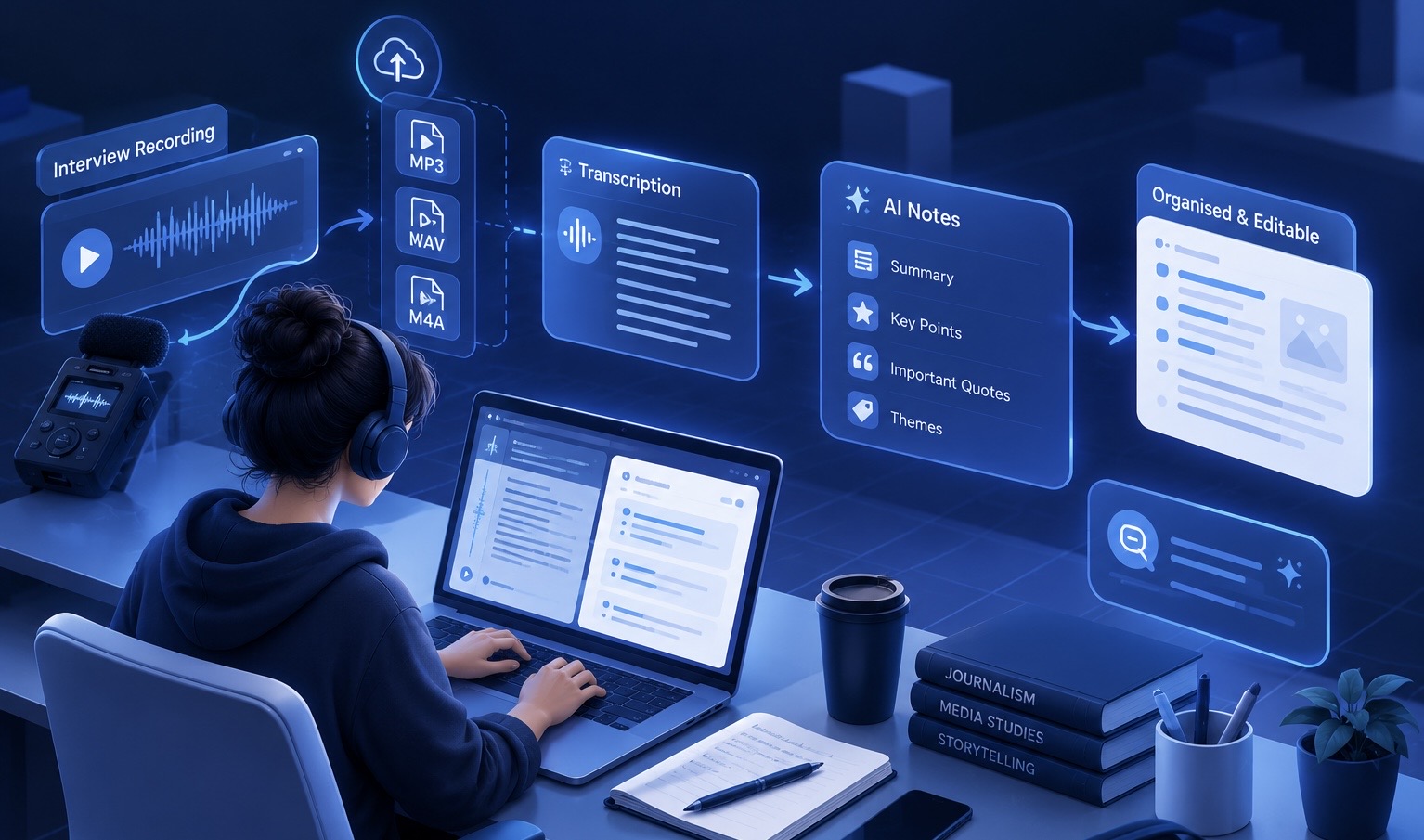
Upload and Transcribe Interviews with INKKD
An efficient interview workflow begins with converting raw audio or video recordings into accurate, editable text. Uploading interview files to INKKD enables media students to transform recorded conversations into searchable transcripts for editorial analysis, research, and assignment preparation.
Clear recordings generally produce more reliable automated transcriptions. Students working across Salford, Greater Manchester, and other reporting locations may capture multi-speaker discussions, background noise, regional accents, and rapid exchanges that require careful audio management.
- Export the recorded interview from the recording device or field recorder in a supported audio format.
- Upload the interview file to the INKKD transcription workspace.
- Review the available transcription settings before processing the recording.
- Allow the system to convert spoken dialogue into text.
- Review speaker changes and flag unusual terminology, regional expressions, or technical jargon for verification.
Searchable transcripts make it easier to locate important testimony during deadline-driven post-production. They also provide a useful reference throughout the writing, editing, and fact-checking process.
Generate AI Notes from Recorded Conversations
Long interviews and panel discussions often contain extensive background information that can obscure the central story. AI-generated notes help condense lengthy conversations into key points, significant statements, and recurring themes.
Summarising recorded dialogue allows student journalists to identify the structure of an interview without repeatedly reviewing the entire transcript. These notes can support editorial planning and help researchers evaluate how effectively their sources answered the original questions.
Key Point Summaries
Condense lengthy explanations and anecdotes into their central arguments. AI-generated summaries can help identify the interviewee's main message while reducing the time spent reviewing repetitive conversational details.
Important Statements
Identify potentially significant claims, official statements, and consequential assertions made during the interview. Flag these passages for factual verification, further research, and editorial follow-up before including them in an assignment.
Interrogate Transcripts with AI Chat
AI chat tools provide a convenient way to retrieve specific information from extensive transcripts without repeatedly scrolling through lengthy conversations. Media students can ask targeted questions to locate responses, clarify terminology, and investigate complex explanations.
Searching transcript content directly helps researchers recover forgotten statements from long discussions. This targeted approach also makes it easier to confirm context before incorporating a soundbite into an assignment.
Students can ask questions such as:
- "What specific rationale did the speaker provide regarding community funding changes?"
- "Which timeline did the interviewee establish for the urban redevelopment plan?"
- "What concerns did the interviewee raise about local media coverage?"
- "Did the speaker mention any figures or statistics that require verification?"
Precise questions help students retrieve relevant information more efficiently. They can also investigate apparent contradictions, policy details, and reactions expressed across different sections of an interview. All AI-generated answers should be checked against the original transcript and recording.
Transfer Notes into Documents and Verify Against Audio
Once relevant insights and quotations have been identified, transferring structured notes into a document editor creates an editable foundation for assignment writing. Copying formatted notes into Word or another writing application helps students refine their prose, organise evidence, and prepare scripts.
- Check names, titles, and proper nouns against official records and source spellings.
- Compare direct quotations against the original audio to confirm the exact wording and context.
- Review AI-generated summaries to ensure important nuances, qualifications, and caveats remain intact.
- Flag unclear transcript segments for a second listening session using suitable headphones.
- Format verified quotations and notes according to the required university or departmental style guide.
Maintaining a consistent verification process helps protect student journalists from accidental misattribution. Comparing written material with the original recording supports factual accuracy across articles, reports, and other editorial outputs.
Frequently Asked Questions
Can AI notes replace listening to the complete recording?
AI notes provide quick thematic overviews but cannot fully convey emotional inflection, hesitation, or vocal nuance. Listening back to relevant sections of the original recording remains essential for authentic storytelling and reliable attribution.
What privacy considerations apply when uploading interview files?
Students should respect interviewee consent agreements, university privacy guidance, and applicable data protection requirements. Sensitive personal information should be handled according to institutional policies and the transcription service's privacy terms. Anonymise identifying details where appropriate and obtain any required consent before uploading recordings.
How should students verify direct quotes extracted by AI?
Locate the corresponding passage in the transcript and listen to the exact section of the original audio. Confirm the wording and review the surrounding sentences to ensure the quotation preserves the speaker's intended meaning and context.